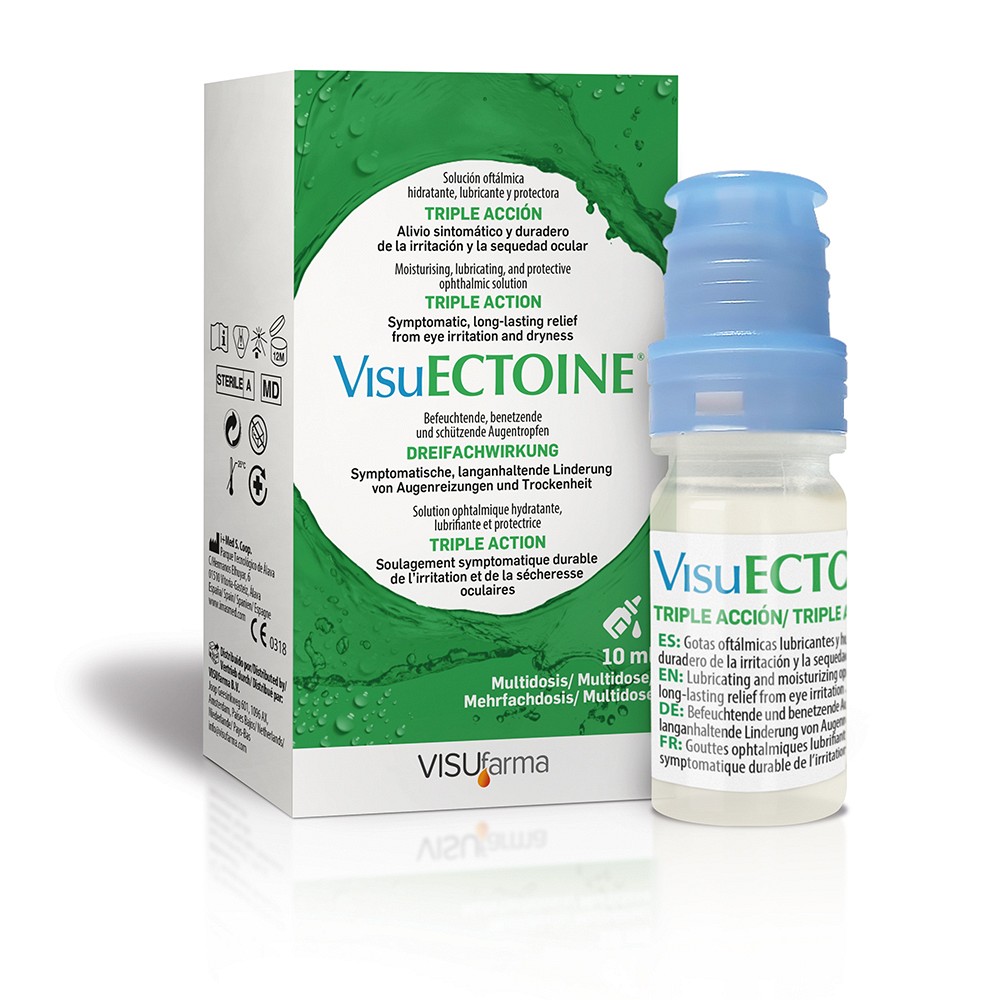
Die ersten Augentropfen mit Dreifachwirkung gegen Augenallergien und -reizungen
3 Inhaltsstoffe zum ersten Mal vereint
VisuECTOINE® kombiniert zum ersten Mal die 3 Inhaltsstoffe Ectoin, Hyaluronsäure und Natriumcarboxymethylcellulose und stellt die ersten Augentropfen mit Dreifachwirkung gegen Augenallergien und -reizungen dar. Es bietet Schutz, effektive Feuchtigkeit und lang anhaltende Linderung gegen externe Allergene oder Umweltfaktoren. 1,2,3,4,5,8
SCHUTZ
Ectoin ist eine entzündungshemmende Komponente, die einen Schutz in der Bindehaut gegen Augenreizungen und Allergien gegen externe Allergene oder Umweltfaktoren bietet.1,2
EFFEKTIVE FEUCHTIGKEIT
Hyaluronsäure ist eine natürlich vorkommende Komponente und zeigt viskoelastische und feuchtigkeitsspendende Eigenschaften. Hyaluronsäure schmiert die Augenoberfläche, reduziert die Reibung beim Blinzeln und bei Augenbewegungen und sorgt für eine effektive Feuchtigkeit.3,9,10
LANG ANHALTENDE LINDERUNG
Natriumcarboxymethylcellulose ist eine mukoadhäsive und viskose Komponente, die an Hornhautepithelzellen bindet, was die Verweildauer im Auge verlängert und für eine lang anhaltende Linderung sorgt.
VisuECTOINE® bietet einen 12 Stunden langen Schutz mit einer einzigen Dosierung.
Außerdem ist VisuECTOINE® für Kontaktlinsenträger geeignet sowie konservierungsmittel- und phosphatfrei.
Anwendungsempfehlung:
Die empfohlene Dosis beträgt ein oder zwei Tropfen in jedes betroffene Auge so oft wie nötig oder wie von Ihrem Facharzt verordnet.
1. Dwivedi, M., Brinkkötter, M., Harishchandra, R. K. & Galla, H. J. Biophysical investigations of the structure and function of the tear fluid lipid layers and the effect of ectoine. Part B: Artificial lipid films. Biochim. Biophys. Acta – Biomembr. (2014). 2. Bilstein, A., Heinrich, A., Rybachuk, A. & Mösges, R. Ectoine in the Treatment of Irritations and Inflammations of the Eye Surface. BioMed Research International (2021). 3. You, I. C. et al. Comparison of 0.1%, 0.18%, and 0.3% Hyaluronic Acid Eye Drops in the Treatment of Experimental Dry Eye. J. Ocul. Pharmacol. Ther. 34, 557–564 (2018). 4. Kojima, T. et al. The effects of high molecular weight hyaluronic acid eye drop application in environmental dry eye stress model mice. Int. J. Mol. Sci. 21, (2020). 5. Garrett, Q. et al. Carboxymethylcellulose binds to human corneal epithelial cells and is a modulator of corneal epithelial wound healing. Investig. Ophthalmol. Vis. Sci. (2007). 6. La Rosa, M. et al. Allergic conjunctivitis: A comprehensive review of the literature. Italian Journal of Pediatrics (2013). 7. Messmer EM. The pathophysiology, diagnosis, and treatment of dry eye disease. Dtsch Arztebl Int. 2015;112(5):71-82. doi:10.3238/arztebl.2015.0071. 8. Gebrauchsinformation VisuECTOINE®. 9. Rah, M. J. A review of hyaluronan and its ophthalmic applications. Optometry 82, 38–43 (2011). 10. Aragona, P., Papa, V., Micali, A., Santocono, M. & Milazzo, G. Long term treatment with sodium hyaluronate-containing artificial tears reduces ocular surface damage in patients with dry eye. Br. J. Ophthalmol. (2002). 11. Lee, J. H., Lee, J. S., Kim, S. & Lee, J. E. Comparison of cytotoxicities and wound healing effects of diquafosol tetrasodium and hyaluronic acid on Human corneal epithelial cells. Korean J. Physiol. Pharmacol. (2017). 12. Yao, K., Bao, Y., Ye, J. et al. Efficacy of 1% carboxymethylcellulose sodium for treating dry eye after phacoemulsification: results from a multicenter, open-label, randomized, controlled study. BMC Ophthalmol 15, 28 (2015). 13. Simmons, P. A. & Vehige, J. G. Investigating the potential benefits of a new artificial tear formulation combining two polymers. Clin. Ophthalmol. (2017).

 Versand aus Deutschland